Parallel build
The docs site run, as its plan drew it. Six tasks have no incoming edge, so they start together.
flowchart LR
  T1["T1 skeleton"]
  T2["T2 facts: start, flows"]
  T3["T3 facts: run, sessions"]
  T4["T4 facts: reference"]
  T5["T5 style guide"]
  T6["T6 check_pages"]
  T7["T7 start pages"]
  T8["T8 flow pages"]
  T9["T9 run pages"]
  T10["T10 sessions pages"]
  T11["T11 reference pages"]
  T12["T12 publish"]
  T1 --> T7 & T8 & T9 & T10 & T11
  T2 --> T7 & T8
  T3 --> T9 & T10
  T4 --> T11
  T5 --> T7 & T8 & T9 & T10 & T11
  T6 --> T12
  T7 & T8 & T9 & T10 & T11 --> T12
How it works
Section titled “How it works”Picture a kitchen. Several cooks start dishes that do not need each other. Only the plating waits for the dishes it plates.
Waves and the task graph. The machine plan draws an edge Tn --> Tm when Tm’s tests execute Tn’s code, or when Tm must read what Tn writes. Tasks with no incoming edges form the first wave and run together. A task that merely uses another’s interface does not wait. It builds against a stub and the e.g. examples in the plan. Waves are a planning view. The scheduler sends a task the moment its dependencies are checkpointed, with no barrier between waves.
Wave 0 holds the manifest, package inits, test config, shared error types and a stub for every interface another task consumes. implementer-haiku builds it. Tasks never wait for its checkpoint, because they build against the stubs.
Tiers. Lint picks the agent from config/routing.json, and nothing overrides it.
| Tier | Agent | Gets | Context limit |
|---|---|---|---|
| Sonnet (default) | implementer |
every task that is not mechanical | 80k |
| Haiku | implementer-haiku |
Kind: mechanical tasks off the critical path |
60k |
The critical path is the longest chain of waiting tasks, so a slow task on it delays the run. It never gets Haiku. A task goes only to an idle agent of its own tier, and nothing queues behind a busy one.
Example: twelve tasks in three waves
Section titled “Example: twelve tasks in three waves”-
You watch. Nothing to answer. Open the agent map to see tasks and agents.
Claude Code · ~/superlite ❯ /superlite:agentsWave 1 is six tasks at once: T1 skeleton, T2, T3 and T4 (three fact sheets), T5 style guide and T6 check_pages.
superlite-cli dispatchpacks every ready task into one message. They share no edge and own different files, so they cannot collide. The report later showspeak 6 at once, which is this wave.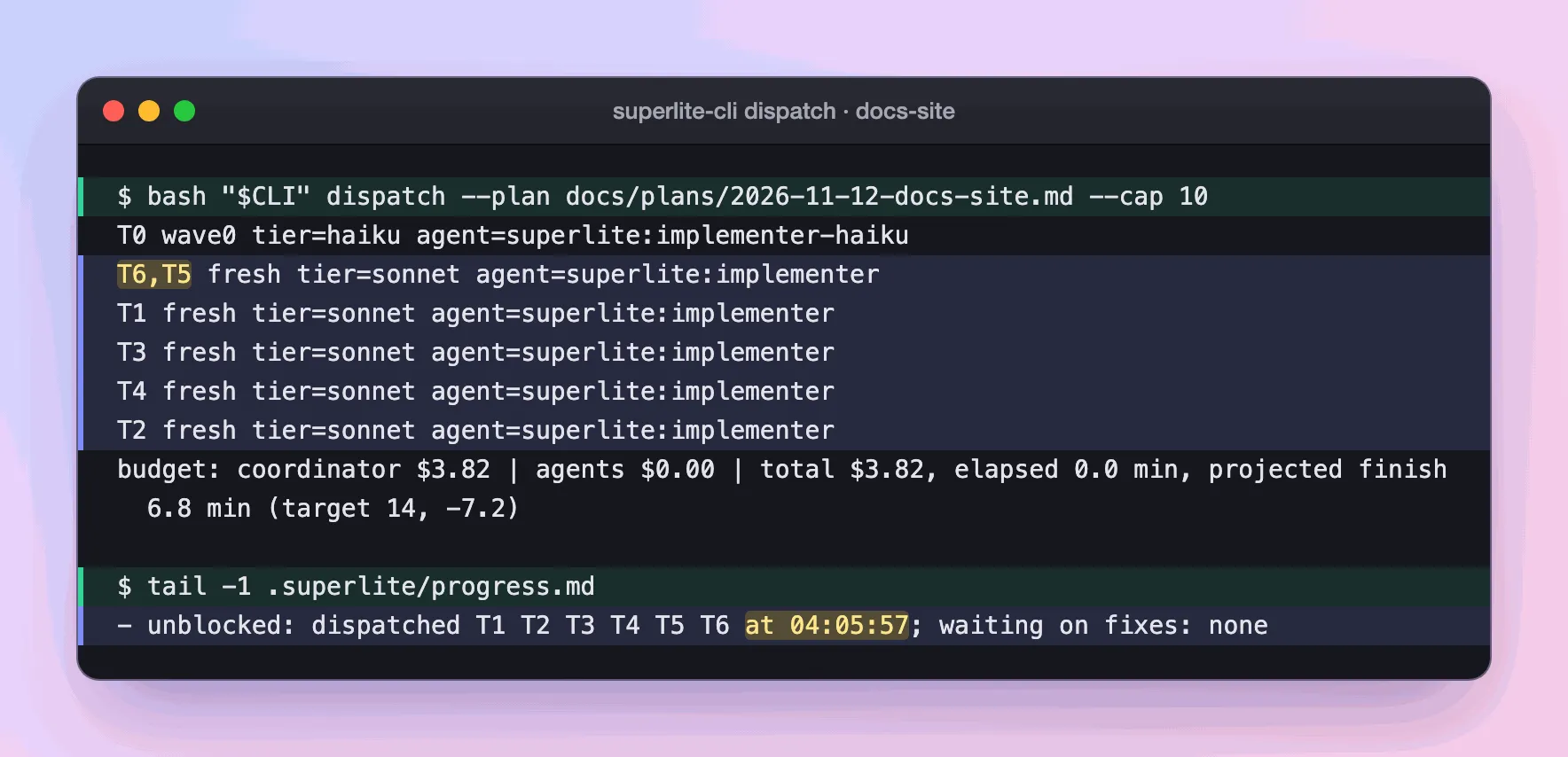
Real output: the dispatch lines that start the wave.
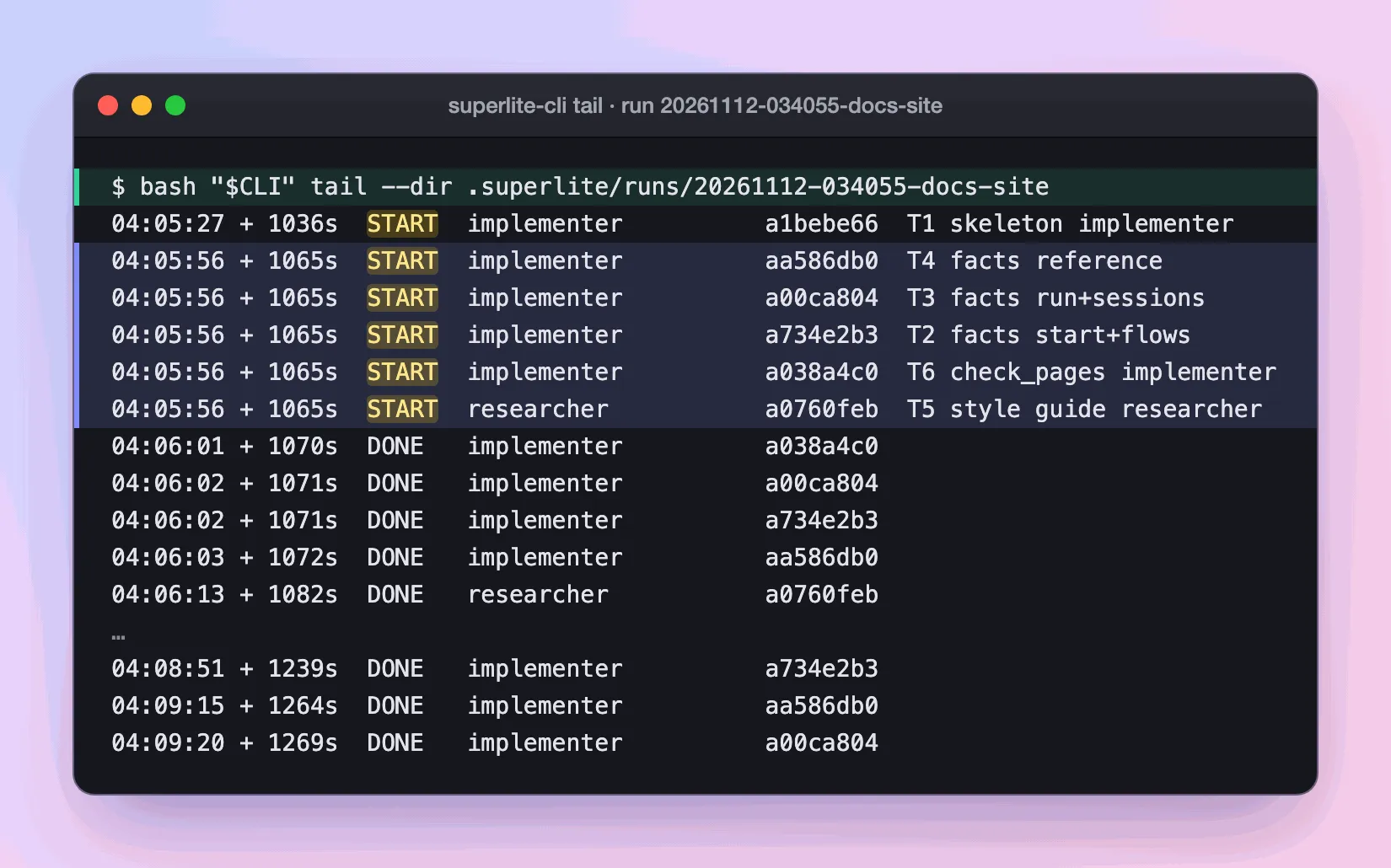
Real output: six agents start together, and finish a few seconds apart.
-
Wave 2 starts task by task. T7 to T11 are the page tasks. Each waits for T1, T5 and the facts file it writes from. This is the edge list the plan holds for T9, the run pages.
docs/plans/2026-11-12-docs-site.md T1 --> T9T3 --> T9T5 --> T9These are content edges, the ruling from the orchestrator page: a page writer cannot guess the facts. T10 needed only T1, T3 and T5, so it could start before T4 finished. There is no barrier between waves.
-
Each agent builds one task. It first reads a shared prime: rules, the plan header, global constraints and each stable task’s title, files and interfaces. Then it fetches its own task.
agent for T9 $ superlite-cli task T9 --plan docs/plans/2026-11-12-docs-site.mdThe prime is the same for every agent, so the shared part is cached and each task brief stays short. The agent writes a failing test, runs it, implements, runs again, and replies DONE, DONE_WITH_CONCERNS, NEEDS_CONTEXT or BLOCKED in at most 200 words.
-
The tiers split the work. Eleven tasks went to Sonnet
implementer. T12 is a workflow file and a README line with exact steps, so the plan marks it forimplementer-haiku.docs/plans/2026-11-12-docs-site.md ### T12 publish · Complexity 2 · Est. context 25k**Owns:** site/.github/workflows/deploy.yml, site/README.md, README.md**Kind:** mechanical**Model:** haikuHaiku costs less, and a mechanical task has little to get wrong. The report shows T12’s model as
?, so treat that one as unmeasured. -
The coordinator checkpoints each result with
superlite-cli checkpoint Tn. The task’s own files are saved underrefs/superlite/*, a hidden ref, not a commit on your branch.Tn FAILEDmeans it touched files it does not own, or has syntax or import problems, and it goes back to its agent. -
Wave 3: T12 publish waits for all five page tasks and for T6, the check script, because it adds the deploy workflow that runs that check. Then you read how it went.
docs/plans/2026-11-12-docs-site.report.md concurrency: peak 6 at once (projected 6); critical path actual T4 T11; projected T1 > T8 > T12 (6.8 min)The actual critical path was T4 then T11: the reference facts took 3.3 minutes and the reference pages waited for them. The twelve tasks added up to 23.4 task-minutes inside 6.3 minutes of wall-clock, about 3.7 tasks running at any moment.
What you end up with: twelve checkpointed tasks, none committed, and tests that ran in the background the whole time. The reviews come next.
Good to know
Section titled “Good to know”- Tests never block the build.
run_testswrites.superlite/test-summary.jsonin the background, and a rawpytestis rewritten into it. A hidden wait is denied. - No agent spawns agents. The coordinator is the only dispatcher.
- Cost caps warn at 70% of the cap. Over the cap, optional work stops.
/superlite:statusshows state./superlite:stophalts dispatching cleanly, and/superlite:resumecontinues from the last checkpointed, tested wave.
Reviews and fixes covers what happens to the checkpointed work.