Research flow
RESEARCH ------------------------------------------------------------------------------ [1 ASK] v [2 PLAN] v [3 QUESTIONS] v [4 APPROVE] v [5 RESEARCH] <------------------+ v | [Agent A] [Agent B] [Agent C] | gaps found (one sub-question each, as many as needed) v | [6 CONTRADICTIONS] -------------+ v [7 LINT] every claim sourced, every conflict has a cause v [8 WRITE] report at your level: Director | VP | Researcher | Simple v [9 DOWNLOAD] optional, only on your yes ------------------------------------------------------------------------------ 1 ASK You give the topic and pick the language level. 2 PLAN Scope, sub-questions, search strategy, evidence tiers. 3 QUESTIONS Critical questions asked of you (or the agent) up front. 4 APPROVE Human mode: you approve the plan. AI mode: skipped. 5 RESEARCH Agents side by side write sources and claims to a ledger, never to the report. 6 CONTRADICTIONS Conflicts found, cause recorded, resolved or left open. Gaps go back to 5. 7 LINT Checks citations, causes, and that all levels match. 8 WRITE Report, sources and contradictions as markdown. Same facts and depth at every level, only wording changes. 9 DOWNLOAD Lists name, source and size. Fetches only after a yes. ------------------------------------------------------------------------------How it works
Section titled “How it works”The report is not where research happens. Researchers write to a ledger, and the report is rendered from it. This is why the levels cannot disagree.
One ledger, many views. Each researcher takes one sub-question. It records sources (with a date and an evidence grade you defined) and claims (each tied to a source). Researchers never write to the report. The four levels are four renderings of the same ledger. For example, a claim like “recall drops at 95% on large indexes” has one id and one source, and appears in all four. They carry the same claim ids, citations, numbers and conflicts. Only the wording changes, so Simple never loses a fact that Researcher has.
Conflicts get a cause. When two claims disagree, superlite records why: definition, date, population, method, source quality or error. It resolves the conflict or leaves it open and visible. A gap sends the run back to the researchers with a new sub-question.
Lint before write. Lint checks that every claim has a source and every conflict has a cause. After the write step, a second check confirms that all levels match.
Example: vector search, for a VP
Section titled “Example: vector search, for a VP”Say you need a briefing on vector search and you want to know where every number came from.
-
You give the topic and the level.
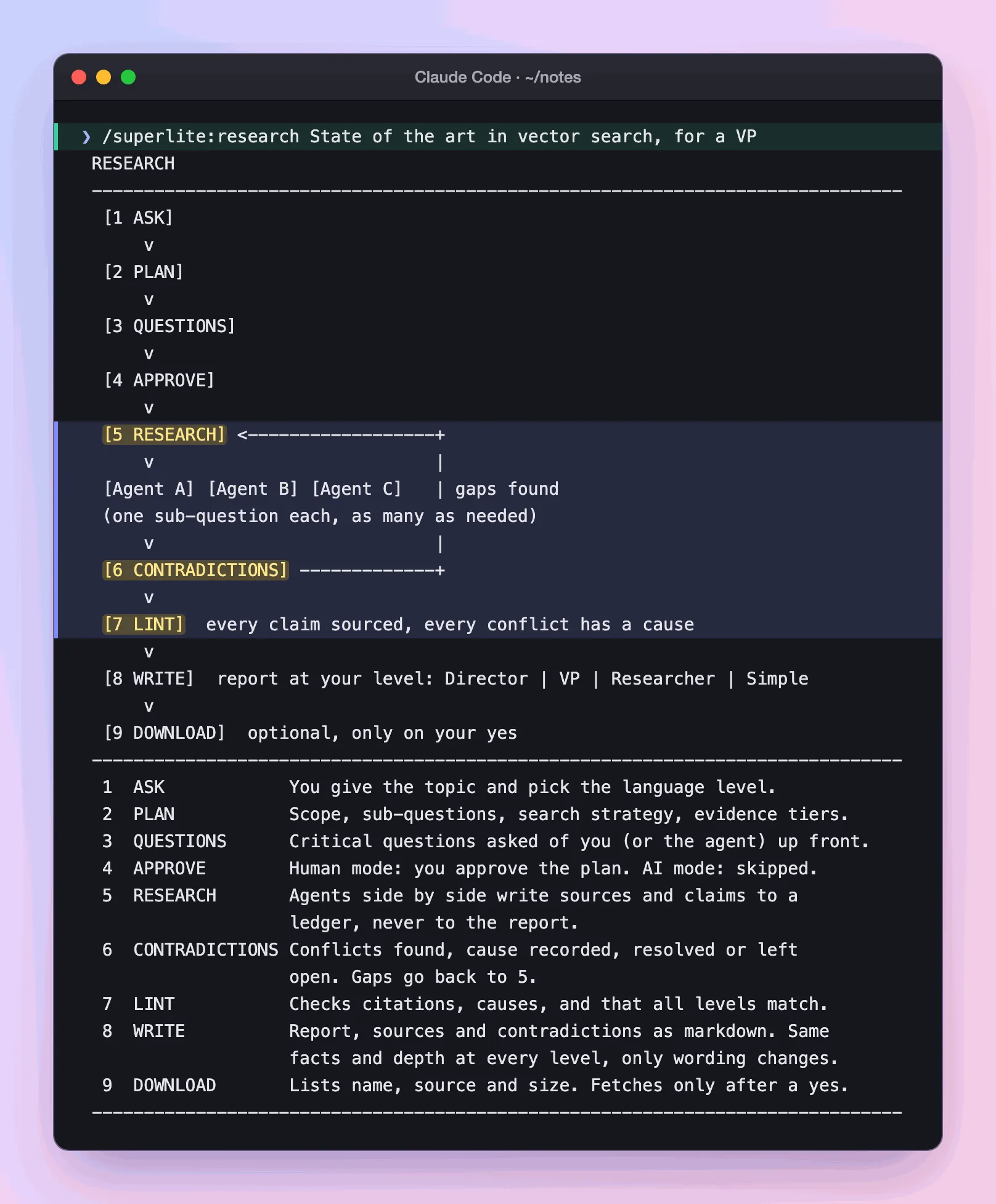
Real output: the command and the screen printed the moment you start.
superlite prints the stored screen above and opens a session. Research needs no code, but the session keeps its files on their own branch.
-
You answer a short menu.
Claude Code · ~/notes Who orchestrates?› 1. Human you approve the plan first2. AI answers its own questionsEvidence tiers? A = peer-reviewed benchmarks, B = vendor docs, C = blog postsYou decide: the orchestrator and what counts as strong evidence. The tiers are yours, and they grade every source later. See orchestrators.
-
You read the plan and approve it.
docs/plans/2026-11-12-vector-search.research.md ## Sub-questions1. Which index types lead on recall at scale?2. What do they cost to run?You decide: approve, after superlite’s batch of critical questions about scope and time range. The plan splits the topic into sub-questions, one per researcher, so the work can run side by side (plan and approval).
-
Researchers run in parallel. Each takes one sub-question and writes sources and claims to a ledger, never to the report.
Directorydocs/plans/
- 2026-11-12-vector-search.research.md the plan
- 2026-11-12-vector-search.sources.md every source, graded A, B or C
Writing to a ledger and rendering the report later is what keeps the levels from disagreeing (parallel build).
-
superlite finds a conflict.
Claude Code · ~/notes two claims about recall disagree: cause "method"It records why they disagree: definition, date, population, method, source quality or error. It resolves the conflict or leaves it open and visible. A gap sends researchers back with a new sub-question.
-
Lint, then the report. Lint checks that every claim has a source and every conflict has a cause. The report is written at VP level, and downloads are listed with name, source and size but fetched only after your yes.
Claude Code · ~/notes Download any of these files? (none fetched yet)❯ no downloadsDirectorydocs/plans/
- 2026-11-12-vector-search.findings.md the VP report
- 2026-11-12-vector-search.contradictions.md conflicts and causes
-
Later you want it in plain language. No new research is needed.
Claude Code · ~/notes ❯ /superlite:research --level simplesuperlite re-renders the report from the ledger and lints that the levels match.
What you end up with: a sourced report, its sources and its conflicts, all in docs/plans/. Nothing was downloaded without your yes.
Good to know
Section titled “Good to know”- With more than one stored ledger, name the one you want:
/superlite:research --level researcher vector-search. - Downloads are optional. superlite fetches only after your yes, and paywalled items stay as links.
- The human orchestrator approves the plan before researchers start. The AI orchestrator answers the critical questions itself and records them as rulings.
- A run ends with
superlite-cli finishin its session. The report page covers time and cost.