Config
flowchart LR
  S["Shipped defaults: skills/swarm/config"] --> M["Merged settings"]
  O["superlite.json in your project"] --> M
  E["Environment variables"] --> M
  M --> T["Tools: dispatch, predict, run_tests"]
Environment variables and an explicit command flag win over the overlay, and the overlay wins over the shipped defaults.
Shipped files
Section titled “Shipped files”Config lives in skills/swarm/config/.
| File | Holds |
|---|---|
models.json |
Prices (USD per million tokens) and output speed per model. |
predictor.json |
Time and context coefficients for predict. |
gitignore.json |
Ignore entries per language; Wave 0 appends missing ones to .gitignore. |
testprobe.json |
Hung-test probe thresholds. |
routing.json |
Task features to tier (haiku or sonnet), tier limits, stats gate. |
hosts/cursor.json |
Per-IDE job to model-slug candidates. |
compact.json |
The compact command each host uses for the compact nudge. |
| Model | Input | Output | Cache read | Tokens per second |
|---|---|---|---|---|
| opus | 4.00 | 20.00 | 0.20 | 45 |
| sonnet | 2.00 | 10.00 | 0.10 | 80 |
| haiku | 0.10 | 0.50 | 0.01 | 150 |
Prices are USD per million tokens.
Project overlay
Section titled “Project overlay”A committed superlite.json at your project root overlays these defaults. A missing file changes nothing. version must be 1.
| Key | Effect |
|---|---|
cap |
Dispatch cap, default 10, which an explicit --cap overrides. |
gitignore |
Lines appended after the shipped list. |
hosts |
Replaces a job’s candidate list. |
testprobe |
Threshold overrides. |
models |
Numeric prices on existing model names. |
compact_tokens |
Context size that triggers the compact nudge, default 150000. |
Unknown keys exit 2 and name the file. The file does not replace routing.json, and a critical-path task never gets haiku.
Environment
Section titled “Environment”| Variable | Effect |
|---|---|
SUPERLITE_TESTPROBE=0 |
Turns the hang probe off. |
SUPERLITE_TESTPROBE_CONFIG=<path> |
Uses another probe config. |
SUPERLITE_PYTHON |
Skips the interpreter probe. |
SUPERLITE_COMPACT_TOKENS=<n> |
Sets the compact nudge size, ahead of compact_tokens. |
SUPERLITE_NO_AUTOCOMPACT=1 |
Silences the compact nudge. |
SUPERLITE_NO_COST_REPORT=1 |
Silences the cost line. |
Example: lowering the cap for one project
Section titled “Example: lowering the cap for one project”Say your laptop struggles when many agents run at once, and your project writes .sqlite files you never want committed.
-
You create
superlite.jsonat the root of the project:superlite.json {"version": 1,"cap": 6,"gitignore": ["*.sqlite"]}versionmust be1. Commit the file, and everyone who builds in this project gets the same settings. -
You start a build as usual. Before the first task goes out, superlite merges three layers: the shipped files in
skills/swarm/config/, then yoursuperlite.json, then environment variables and command flags.The overlay is small on purpose. You write only what differs, and a missing file changes nothing.
-
The build’s first step, Wave 0, appends
*.sqliteto.gitignoreafter the shipped list for your language. Thendispatchruns with a cap of 6 instead of 10. It sends a ready task out only while fewer than 6 are running.Directoryyour-project/
- superlite.json the overlay you committed
- .gitignore now ends with
*.sqlite
-
You decide: on a day you want more speed, pass
--cap 10to one dispatch call. A flag beats the overlay for that call and leaves the file alone.Terminal · ~/social $ bash skills/swarm/scripts/superlite-cli dispatch --cap 10 -
Say you mistype the key as
cappp:superlite.json {"version": 1,"cappp": 6}The next command exits with code 2 and names
superlite.json, even when you pass--cap. superlite does not ignore the line and run with the wrong setting. -
Some settings are not in the overlay. Three are kept per user, and each has a status command.
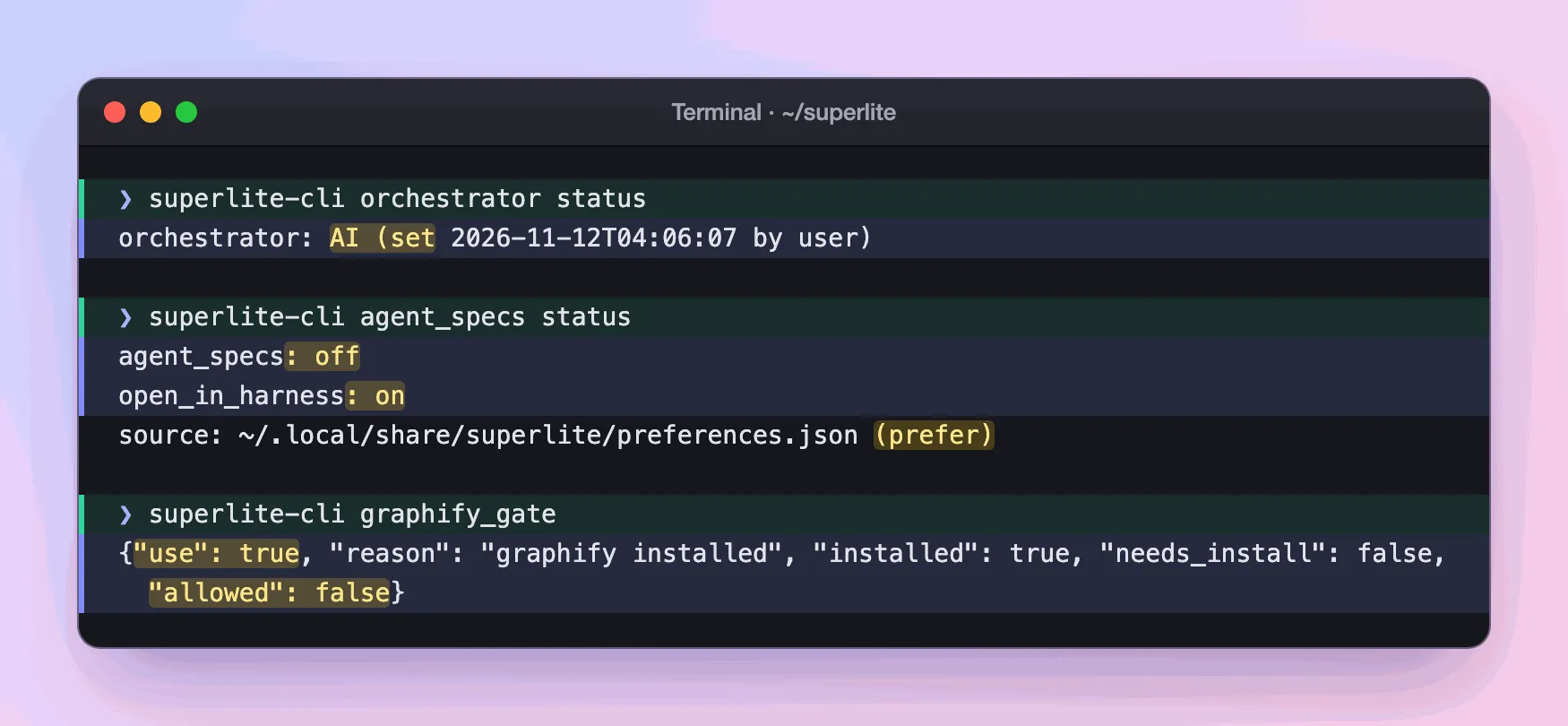
Real output: the orchestrator mode, the agent-specs preference and the graph-tool gate, read from the user’s own settings.
What you end up with: one committed file that changes the concurrency and the ignore list for this project only. The shipped defaults, routing.json and the rule that a critical-path task never gets haiku stay as they were.