
Gates
flowchart LR
  P["Plan"] --> L["Lint"]
  L --> A{"You approve?"}
  A -->|"yes"| D["Dispatch by tier"]
  D --> B["Agents build"]
  B --> T["Tests in background"]
  T --> R["Review and report"]
  A -->|"no or a question"| P
Along the whole line, the pre-tool hook blocks code edits by the coordinator and name-based kills, and the budget line watches cost.
The gates
Section titled “The gates”Instructions drift. Scripts and hooks do not.
| Gate | What it enforces | How |
|---|---|---|
| The coordinator cannot write code | Every change goes to a fix-only or implementer agent, by tier. | pre-tool hook |
| You approve before orchestration | In human mode nothing is linted, dispatched or sent to an agent until a typed reply approves the review plan. | pre-tool, prompt, superlite-cli orchestrator |
| No unsafe kills | No pkill or taskkill /IM; only PIDs the run started. |
pre-tool hook |
| Tests never block the coordinator | Raw pytest, npm test, go test become a background superlite-cli run_tests. |
pre-tool hook |
| No hidden waits on tests | A test run in until/while or sent to /dev/null is denied; use run_tests --wait. |
pre-tool hook, hang probe |
| A plan must lint first | Stable tasks dispatch at once, others wait with a reason. | lint --stable |
| Same plan, same agents | Task features pick the tier from routing.json; Haiku only for mechanical tasks off the critical path. |
routing.py |
| Agents stay in their tier | A task goes only to an idle agent of its own tier. | dispatch |
| Cost caps are enforced | Warns at 70% of the cap; over the cap it stops optional work. | superlite-cli budget |
| Every run is measured | Tokens, cost and time are captured and feed the next predictions. | capture hooks, history.jsonl |
| No agent spawns agents | Subagents get explicit tool lists with no Agent. |
agent definitions |
Any clear approval counts: yes, go ahead, looks good, lgtm. A refusal, a question or a bare mention does not. The reply must be newer than the review plan.
Example: the approval gate stops an early build
Section titled “Example: the approval gate stops an early build”Say you work in human mode and ask for CSV export on the reports page.
-
You type the request in Claude Code:
Claude Code · ~/social Add CSV export to the reports pagesuperlite explores the code, then the coordinator writes a review plan, the short document you read before anything is built.
-
Say the coordinator moves too fast and calls
superlite-cli dispatchbefore you have answered. You see the call refused:Claude Code · ~/social $ superlite-cli dispatch ...Human orchestrator: no build is orchestrated until the human approves the plan.Write the review plan docs/plans/<date>-<topic>.review.md ...The
pre-toolhook blocks it. In human mode nothing is linted, dispatched or sent to an agent until your approval is on record. This gate exists so that you, not the model, decide when spending starts. -
The coordinator ends its turn and shows the path to the plan, a five-line summary and a closing line.
Claude Code · ~/social docs/plans/2026-11-12-csv-export.review.mdReply approve to start, or tell me what to changeYou decide: read the plan. Reply “looks good” to approve, or say what to change and the plan is revised. A refusal, a question or a bare mention of the word does not count as approval.
-
You reply:
Claude Code · ~/social looks goodThe
prompthook records your reply in.superlite/human-replies.jsonl, and the coordinator runssuperlite-cli orchestrator approve --review docs/plans/2026-11-12-csv-export.review.md.The approve call checks that your reply is newer than the review plan. The coordinator cannot write that file itself, because the same hook protects it. A stale or missing reply makes the call exit with BLOCKED.
-
The build starts.
lint --stablesorts the tasks: stable ones go out at once, the others wait with a reason. Test runs go to the background. A budget line reports cost against the cap and warns at 70%.These later gates need nothing from you. They turn up only when something goes wrong, for example when a test run hangs or spending passes the cap.
-
The final review is also a gate. A fresh reviewer must answer from a packet that lists every open item, so nothing is judged from memory.
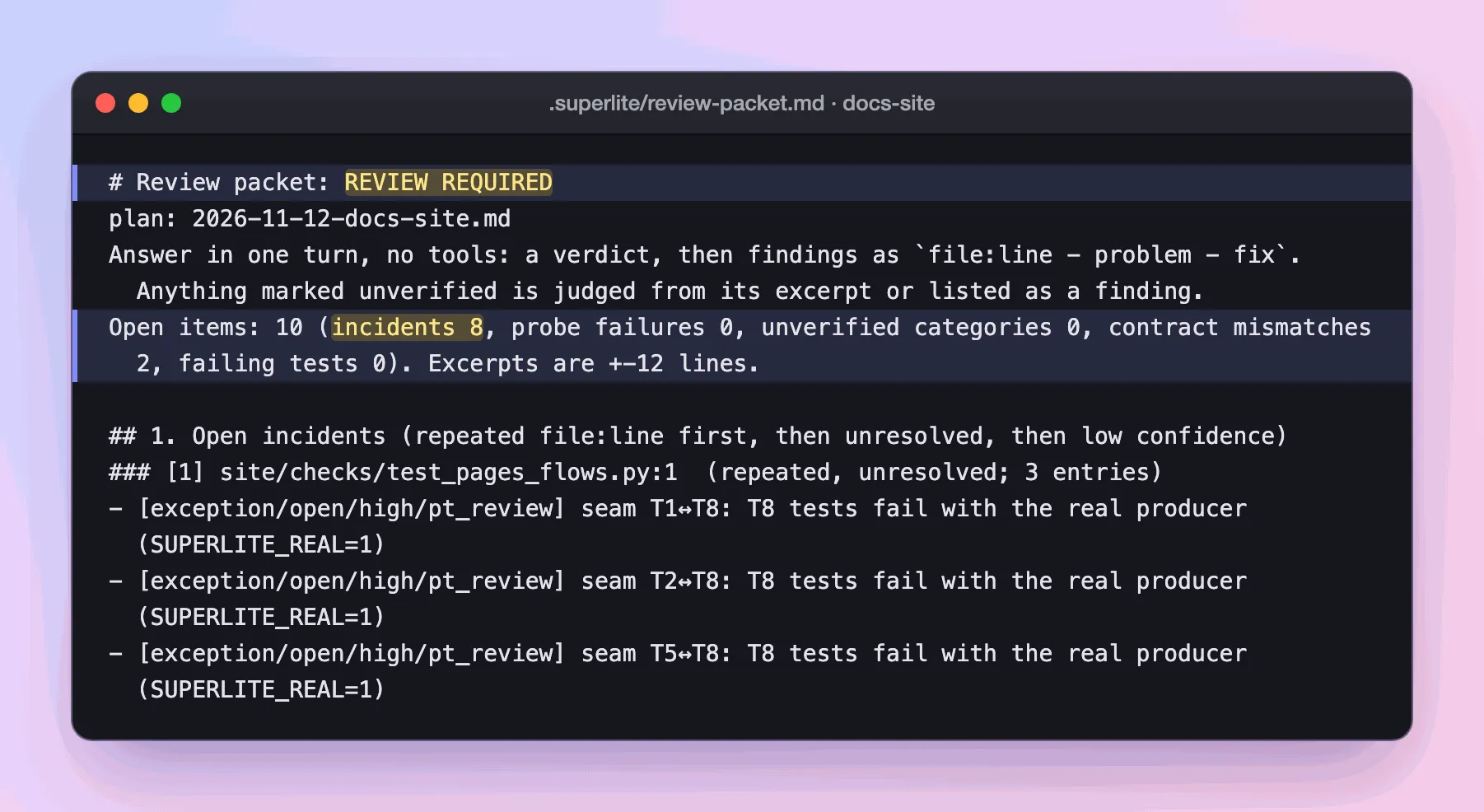
Real output: the head of the review packet from the run that built this site. It reports 10 open items, 8 of them incidents and 2 contract mismatches.
What you end up with: a build that started only because you said yes, on a plan you read. The reply that unlocked it is stored beside the plan. See Plan and approval for the full flow.